
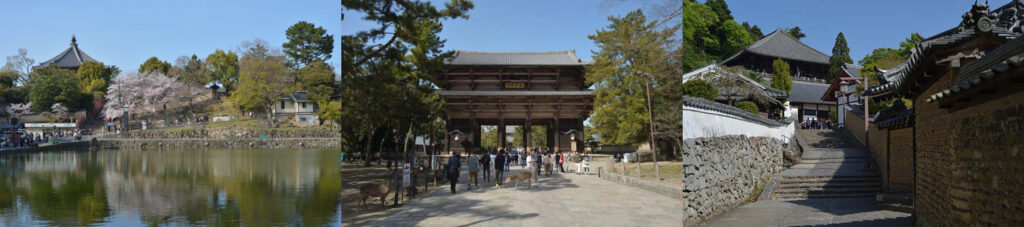
Understanding large temple complexes in Nara
When people think of Nara’s temples, they often imagine one famous building.
But large temples were never designed as single structures.
They were built as places, made up of many halls with different roles.
Understanding this simple idea makes visiting major temples much easier—and much calmer.
Why large temples have many halls
In the past, large temples were more than places for prayer.
They were centers of learning, administration, ceremonies, and daily activity.
Each hall had a purpose, and together they formed a working space rather than a single destination.
Some halls were used for important rituals.
Others were for study, storage, memorial services, or quiet practice.
What remains today is not one building, but a layout shaped by function.
The main hall and the surrounding halls
Most large temples have a main hall that draws attention first.
This hall usually held the principal statue and served as the symbolic heart of the complex.
Around it, smaller halls were placed with intention.
They supported the main hall, both physically and spiritually.
When you walk through a large temple area, try not to rush toward one building.
Instead, notice how the halls are positioned and how the paths connect them.
The space between buildings is also part of the design.
You don’t need to see everything
Large temple grounds can feel overwhelming at first.
It is perfectly fine to focus on just one or two halls.
Seeing everything is not the goal.
Understanding why there are many halls is often more meaningful than visiting them all.
If one area feels quiet or draws your attention, that is enough.
Temples were never meant to be consumed quickly.
How this helps while walking
Knowing that a temple is a complex—not a single spot—changes how you walk.
You may choose a slower route.
You may skip a building without feeling that you missed something.
You may notice how the temple connects to the surrounding land and roads.
This perspective makes walking through Nara more relaxed and personal.
Related pages
- Todai-ji: Main Hall and surrounding halls
A closer look at how a major temple complex is arranged - Kofuku-ji area overview
Understanding the relationship between halls, pagodas, and open space
Walk through a temple area
If you would like to experience these ideas while walking,
you can explore routes that pass naturally through major temple areas.
A gentle reminder
Large temples are not puzzles to solve.
They are places shaped by time, use, and human movement.
Understanding their structure allows you to walk without pressure.
Take your time.
One hall is often enough.