【The Guidance of Knowledge】
This piece was crafted with the help of modern AI to better illuminate the timeless beauty of our ancient heritage.

“On the peak of Mount Mikasa, in the land of Kasuga, the moon rises—the same moon that once shone upon the fields of distant China.” > — Abe no Nakamaro, Manyoshu (Vol. 7-1172)
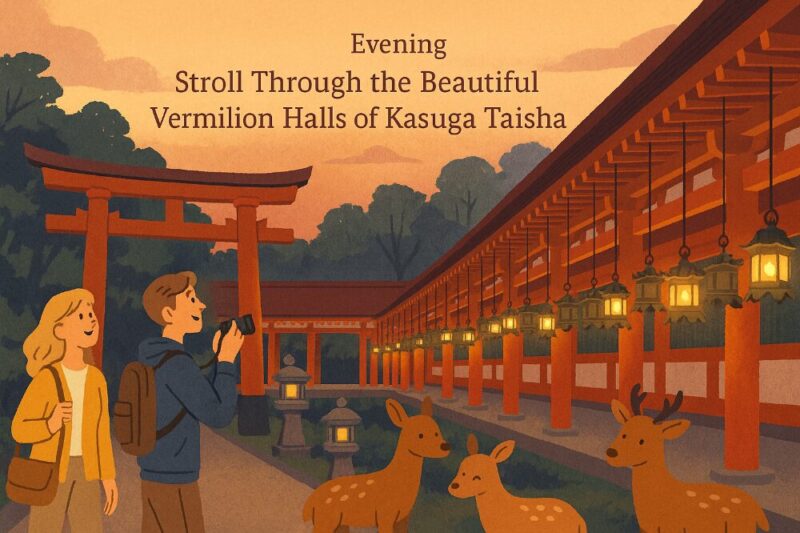
As the sun begins to dip below the horizon, Kasuga Taisha Shrine undergoes a mystical transformation. The vibrant vermilion of the corridors takes on a deeper, warmer glow, and the rustling of the primeval forest becomes the only sound to accompany your footsteps. This is the hour when the boundary between the mundane and the divine fades, and the true soul of Nara reveals itself.
Suggested time: 60–90 minutes. Best experienced at dusk, as the forest shadows begin to stretch and the ancient spirits seem to stir.
Founded in 768 AD to protect the then-new capital, Heijō-kyō, Kasuga Taisha is one of Japan’s most celebrated Shinto shrines and a UNESCO World Heritage site. It served as the tutelary shrine for the powerful Fujiwara clan. For over 1,200 years, it has stood as a symbol of the harmony between imperial authority, nature, and deep spirituality.
The shrine’s architecture, known as Kasuga-zukuri, is characterized by its graceful gabled roofs and the striking contrast between the white walls, cypress bark roofs, and cinnabar-red beams. This aesthetic has remained unchanged through centuries of “Shikinen Zogae”—the tradition of rebuilding the shrine every 20 years to maintain its purity.
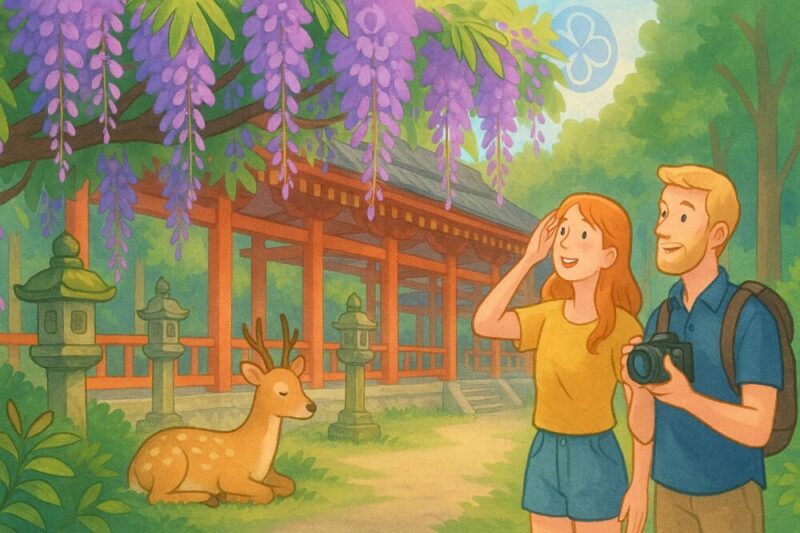
The long approach (Sando) to the shrine is lined with approximately 2,000 stone lanterns, each weathered and coated in soft green moss. These are offerings from worshippers across centuries—from powerful samurai to humble townspeople.
Cultural Insight: If you look closely, you will see a variety of shapes and sizes. The oldest stone lantern dates back to 1136. Each one represents a “light of the heart” (tomoshibi)—a physical manifestation of a prayer once whispered in this forest. You may even spot the names of families or companies engraved on them, proof of centuries of devotion.
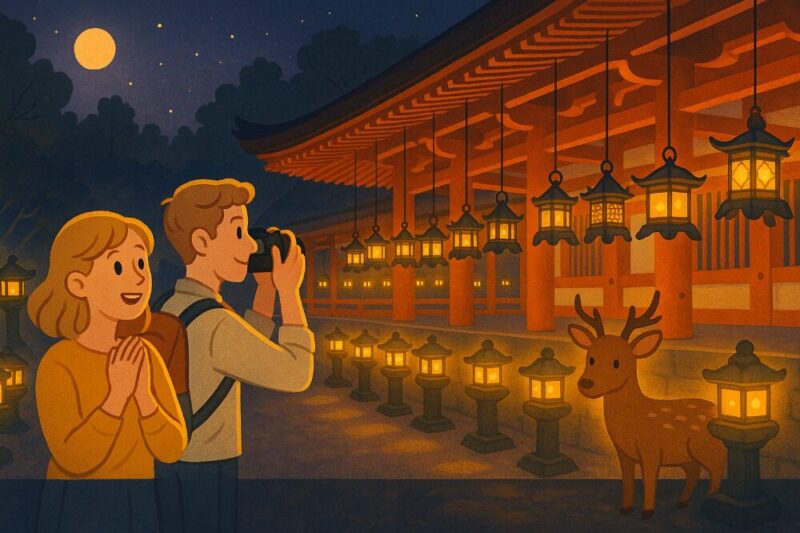
Once you pass through the South Gate, you are surrounded by the famous vermilion corridors. Hanging from the eaves are another 1,000 bronze lanterns, reflecting the artistic heights of the Edo period.
Kasuga Taisha is inseparable from the Kasugayama Primeval Forest, a sacred grove where hunting and logging have been forbidden since 841 AD. This lush wilderness is the true home of the Sacred Deer.
In Shinto tradition, these deer are the Messengers of the Gods (Shinroku). Legend says the deity Takemikazuchi arrived at Mount Mikasa riding a white deer. Seeing them roaming freely among the lanterns in the twilight—their coats dappled by the fading sun—is a scene that captured the hearts of Manyoshu poets.
Visiting Kasuga Taisha in the evening offers a completely different experience from the daytime. As the crowds fade away, the atmosphere becomes calm and mystical. The harmony of nature, history, and tradition reveals itself in the soft evening glow, allowing visitors to feel a closer connection to the shrine’s spiritual essence.
Twice a year—during Setsubun Mantoro (February) and Chugen Mantoro (August)—all 3,000 lanterns are lit at once. The shrine becomes a sea of flickering orange flames, casting dancing shadows against the vermilion wood. It is a breathtaking ritual that connects the living to the ancient prayers of the past.
While the outer grounds are free to wander, the Special Admission to the Main Sanctuary (¥700) offers a deeper encounter.
| Detail | Information |
|---|---|
| Opening Hours | 6:30 AM – 5:30 PM (Apr-Sep) / 7:00 AM – 5:00 PM (Oct-Mar) |
| Special Admission | 9:00 AM – 4:00 PM |
| Admission Fee | Free (Outer grounds) / ¥700 (Main Sanctuary) |
| Official Website | Kasuga Taisha English Site |
As the last light fades from the sky, the transition from the divine forest back to the human world is best made slowly. We suggest a quiet walk back through Naramachi, where the warm lights of traditional merchant houses and cozy cafés offer a bridge between the ancient spirits and the comfort of the modern night.
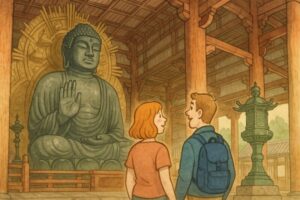 Late Morning|Todai-ji: A Journey into the Heart of Ancient Prayers
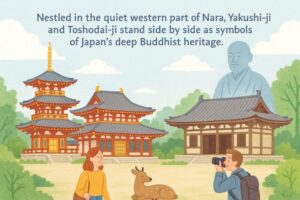 Yakushi-ji & Toshodai-ji: A Journey through the Duality of Faith